Blog
The Road Less Travelled
My first notion that my life was not taking its planned course led me to read my first of what I would consider a non-factual book, having only read about science and biology all my life.
The opening statement, "Life is difficult", set me off on a journey of self-discovery that has not stopped to this day. I guess discovering coaching was an inevitable result of trying to become the best person I can be.
The current Silver Wizard branding came quite naturally from a long beach walk in New Zealand, at a new point in my journey through life, noticing the local shells washed up on the beach, not yet realising the symbolism behind the scallop shell. The scallop shell has become closely intertwined with the Camino de Santiago.
A fellow TCI student had mentioned the Camino and the Road to Santiago, and then the pieces of the puzzle began to fit. We are all on a never-ending journey of self-discovery.
"In the midst of a world both beautiful and broken, there are signs to help lead us forward, sometimes right under our feet."
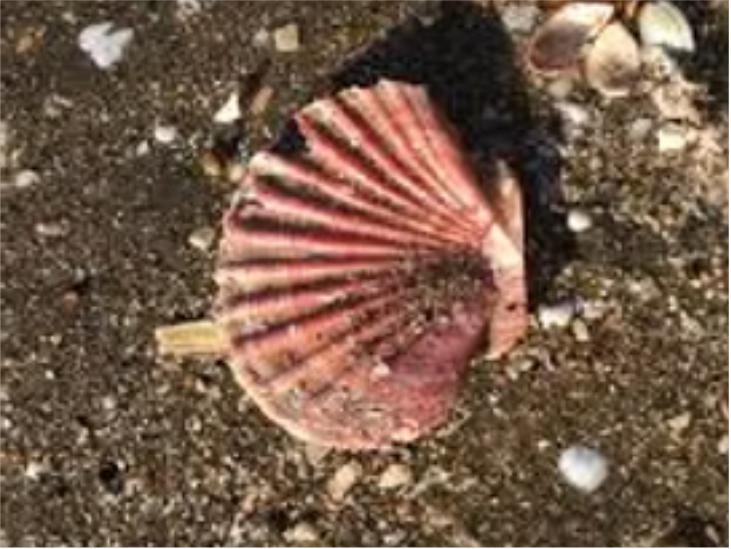
Scallop Shell Symbolism
Give me my scallop-shell of quiet;
My staff of faith to walk upon;
My scrip of joy, immortal diet;
My bottle of salvation;
My gown of glory (hope's true gage)
And then I'll take my pilgrimage.
Sir Walter Raleigh
Scallop shell symbolism is associated with the apostle James. James the Greater was the son of Zebedee, a fisherman of Galilee, and brother of John the Evangelist. He was among the circle of men closest to Jesus, present with Peter and John at the Transfiguration, and again at the Agony in the Garden, where the same three are seen sleeping while Christ prays. A series of legends dating from the Middle Ages tells of his mission to Spain and his burial at Compostela, which then became one of the great centres of Christian pilgrimage, well established by the eleventh century, next in importance to Jerusalem and Rome.
In art, James appears as three distinct types, one of them the pilgrim. He wears the pilgrim's broad-brimmed hat and cloak. From his staff or shoulder hangs the wallet or water-gourd of the pilgrim. His special attribute, the scallop shell, appears on his hat, cloak or wallet.
To this day, on arrival at the Cathedral of Santiago de Compostela, pilgrims present their Pilgrim Passports, duly stamped at each of their halts along the way, at the Cathedral's Pilgrim Office, and apply for the Compostela, the traditional certificate in Latin confirming their completion of the pilgrimage.
The origin of the scallop shell as the badge of the pilgrim to Compostela is open to more than one explanation. Found in abundance along northern Spanish beaches, the shell has become closely intertwined with the Camino de Santiago. Practical observers argue that it was adopted merely as a device for sipping water from streams along the way. If so, it quickly took on greater meaning, even to the earliest pilgrims.
The scallop design symbolises the many European starting points from which medieval pilgrims began their journey, all drawn to a single point at the base of the shell: Santiago de Compostela. Today in Spain, cement scallop shell markers along the Camino reassure participants that they have not taken a wrong turn, and local residents decorate their gardens and houses with shells in solidarity with the pilgrims.
A recent pilgrim recalled that the shells came in various forms: ceramic shells fitted onto road markers, government-issue traffic signs marked with an abstract shell, shining brass shells embedded in sidewalks. Some were broken, some had been taken as souvenirs, leaving only a trace of their presence; some were beautiful, some so simply sketched as to offer the mere suggestion of a shell. In all their variations, they marked the route for hundreds of miles. They reminded all of us, pilgrims, that in the midst of a world both beautiful and broken there are signs to help lead us forward, sometimes right under our feet.